Monday, April 18, 2022

Ishmael by Daniel Quinn

Teacher seeks pupil. Must hast have an earnest desire to save the world
Apply in person

This ad enrages the narrator of the book, Ishmael. Although he has in the past sought a teacher, he is now disillusioned, and angry at the naive audacity of the ad. He answers the ad simply to expose the person who wrote it as a fake. Imagine his response when he discovers just who that is.

Because it was backed by darkness, the glass in this window was black—opaque, reflective. I made no attempt to see beyond as I approached. I was the spectacle under observation. On arrival, I continued to gaze into my own eyes for a moment, then rolled the focus forward beyond the glass—and found myself looking into another pair of eyes.

I fell back, startled. Then recognizing what I’d seen. I fell back again, now a little frightened.

The creature on the other side of the glass was a full-grown gorilla.

And so begins one of the most captivating and insightful books I have read in years. Actually the book had gone through several iterations until Quinn published the current version in 1992.

I’m surprised it took me so long to discover this brilliant treatise on human’s destruction of the earth, quite a fitting topic for our earth-day show.

Yes, he is being interviewed by a gorilla and a very clever one at that. A poster on the wall reads

WITH MAN GONE

WILL THERE 

BE HOPE

FOR GORILLA? 

This koan recurs many times in the book. The gorilla announces, “I am the teacher,’ and so begins an incredibly complex discussion of how we got to where we are, and how we might save ourselves and the rest of sentient life forms on earth.

Once you learn to discern the voice of Mother Culture humming in the background, telling her story over and over again to the people of your culture, you’ll never stop being conscious of it. Wherever you go for the rest of your life, you’ll be tempted to say to the people around you ‘How can you listen to this stuff and not recognize it for what it is?’ and if you do this, people will look at you oddly and wonder what the devil you’re talking about. In other words, if you take this educational journey with me, you’re going to find yourself alienated from the people around you—friends, family, past associates, and so on. 

There is a whole philosophy of history spun out in the gorilla’s lessons, from creation myths to a tracing of the history of agriculture. The story of The Leavers and The Takers. The story is too complex to simply overview, nor am i anything like as clever as Quinn and the gorilla. 

“And so your account of creation ends, ’And finally man appeared.’

“Yes.”

“Meaning what?”

“Meaning that there was no more to come. Meaning that creation had come to an end.”

“This is what it was all leading up to”

“Yes.’

“Of course. Everyone in your culture knows this. The pinnacle was reached in man. Man is the climax of the whole cosmic drama of creation.”

“Yes.”

“When man finally appeared, creation came to an end, because its objective had been reached. There was nothing left to create.”

“That seems to be the unspoken assumption.”

Ishmael is a wise if impatient teacher and he does not simply lay out his theory of how we came to this precipice we are on, he proceeds in Socratic fashion, urging the narrator to dig out the story, and play his part in discovery, to bring out of concealment the story of our own destruction.

At first I thought that the author must have read The Sixth Extinction, and was playing off of it, but if anything, it is the other way around since this novel predates the publication of The Sixth Extinction and centers more on economic history than on scientific data.

In essence, the world was made for man, and man was made to rule it. But since the world would not meekly submit, man had to conquer it.

“I’m saying that the price you’ve paid is not the price of becoming human. It’s not even the price of having the things you just mentioned. It’s the price of enacting a story that casts mankind as the enemy of the world.“

Martin Heidegger tells a similar story in his essay, “The Question Concerning Technology,” in which he claims that the present worlding, the world we are bringing  into existence, treats nature as standing reserve, that which stands in reserve for us to use and use up. Quinn’s version of the story sis far less pompous than Heidegger’s and far more entertaining.

Monday, March 21, 2022

Black Cake by Charmaine Wilkerson

Black Cake is a sprawling, brilliant debut novel by Charmaine Wilkerson. It is hard to believe it is a debut novel, since the writing is so rich and complex, but she has been writing for a long time. 

Benedetta Bennet (known as Benny), and Coventina (Covey) have been best friends for life, and their voices are two of the most important narrative voices in this novel, although there are a host of narrators representing generations of families. The chapters are split between then (1965) and now (2018). Benny and Byron, once super-close siblings have drifted apart as they matured, but the death of Eleanor Bennett, their mother, brings them together, and the narrative she has left behind for them shows them that Eleanor was not the person they or others thought she was. Benny and Byron, or B & B as their mother likes to call them, have been summoned to Eleanor Bennett’s attorney’s office and are given a handwritten note and a USB drive. The note says simply “B and B, there’s a small black cake in the freezer for you. Don’t throw it out.”

As Wilkerson tells us in her Author’s Note:

It was my personal familiarity with a particular Caribbean food, black cake, that led obliquely to this book. It started me thinking about the emotional  weight carried by recipes and other familial markers that are handed down from one generation to the next. Then it had me writing about characters who must hold fast to their sense of self when they learn their lives have been built on a dubious narrative.

What we call holiday fruit cake is as close as most of us come to black cake. But the Caribbean black cake is made with fruit that has been soaked in alcohol over long periods of times, and is especially treasured as a wedding cake.

Not everyone sits down to write a book but everyone is a storyteller, in one form or other. As I wrote this novel, a lifetime of anecdotes and fleeting impressions shared by the Caribbean members of my multicultural family helped me to develop some of the fictional characters and scenarios from the 1950s and 1960s. The scenes from the unnamed island in the Caribbean reflect some of the geography and history of Jamaica...The fictional town where members of the book’s older generation grew up is inspired by the northeast coast of that island and uses a mix of actual and invented locations.

Without telling you much of the story that unfolds as B and B listen to the story their mother tells them, one of the two best friends is given by her father as a bride to a much older and powerful money-lender. Benny, who is a great long-distance swimmer helps Covey to escape the island and the marriage, but must then escape and change her own identity because of the long reach of the money lender and his family.

While B and B slowly learn the real history of their mother, scores of other characters are introduced. Covey eventually becomes a kind of food anthropologist telling family stories via food traditions. Benny becomes s world famous open-water distance swimmer, and eventually marries and moves to the United States.

In many ways Wilkerson displays the dangers for Blacks living in white communities., and in this way the novel seems very current. A black man pulled over for a busted tail light, and while trying to get his wallet, the officer pulls a gun on him.

What was the kid supposed to do if he was asked to show his driver’s license?

How is a person supposed to reach for their wallet? Are black people in America not allowed to have hands?

Byron would like to believe that this epidemic of mistreatment, this bullying of unarmed black men is just that, an outbreak, though prolonged, that can be brought under control. He wants to keep believing in law enforcement officers, to respect the risky work that they do, knowing that every day they step into unknown territory. He wants to know that he can still pick up the phone and call the cops if he ever needs to. There’s a lot of anger out there. A lot of hurt. Where  are they all gonna end up—black white, whoever—if things don’t get better?

Good question, and Wilkerson is a master at spotlighting this and so many contemporary issues. This is a wonderful novel, one of the best I have read in the past two years, and a fitting tribute to Women’s History month. 

Monday, January 03, 2022

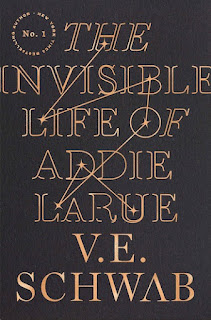
The Invisible Life of Addie Larue by V.E. Schwab

Invisible Life of Addie Larue
Try to imagine what it would be like to not be remembered by anyone. Adeline Larue has made the mistake of praying to the dark gods to be free and to live without fear of death. The title of this Faustian tale is The Invisible Life of Addie Larue, by V.E. Schwab.

The author warns us in a prefatory note which she attributes to Estele Magritte, 1642-1719:

The old gods may be great, but they are neither kind nor merciful. They are fickle , unsteady as moonlight on water, or shadows in a storm. If you insist on calling  them, take heed: be careful what you ask for, be willing to pay the price. And no matter how desperate or dire, never pray to the gods that answer after dark.

I am not a big fan of fantastical literature, but this novel raises so many fascinating philosophical questions  about personal identity and its link to memory that I continued to ponder the questions long after I had finished reading the story, a story which stands on its own even without the philosophical meandering, but which is so much better as a book because of the reflections on personal identity.

Adeline is a girl who lived at the cusp between 1698 and the eighteenth century. Much loved by her father, a woodworker, he always takes her with him when he takes his wares to market. “Adeline is seven, the same as the number of freckles on her face. She is bright and small and quick as a sparrow.” She continues to leave her small village three times a year to go to the city of Le Mans, but when she turns twelve, her parents decide she should no longer be allowed to go to the large town, that it is unseemly for a young girl to wander the market. 

“You are not a child anymore.” 

And Adeline understands and still does not understand at all—feels as if she’s being punished for simply growing up.

And then she is sixteen and, against her will, betrothed to a man more than twice her age.

I do not want to marry.

“I do not want to belong to someone else,” she says with sudden vehemence.  The words are a door flung wide, and now the rest pour out of her. “ I do not want to belong to anyone but myself. I want to be free. Free to live, and to find my own way, to love, or to be alone, but at least it is my choice, and I am so tired of having no choices, so scared of the years rushing by beneath my feet.  I do not want to die as I’ve lived, which is no life at all.

This she tells to a shadow, a handsome man with dark curls and green eyes, a man she comes to call Luc.

The novel jumps from France in 1714 to New York City in 2014. Addie’s wish has been granted and she has lived for over three hundred years. The curse for her freedom and apparent immortality is that no one remembers her. She is forgotten simply by turning her back or walking away. If she takes a man to her bed, she knows he will awaken in the morning startled by the stranger in  bed with him. Although she can get money, usually by stealing, landlords will not rent to a lone woman. It is only when she begins to wear trousers and a buttoned coat, a hat that is pulled down over her face  that she can roam freely. 

The darkness claimed  he’d given her freedom, but really, there is no such thing as freedom for a woman, not in a world where they are bound up inside their clothes, and sealed inside their homes, a world where only men are given leave to roam.

I will return to the story in a moment, but  let us first ask about the connection between memory and personhood. Oliver Sacks describes a man who has no short-term memory at all, but only a hazy recall of a distant past. If philosophers are right, memory is a necessary condition of personal identity, of being the same person over time. Sacks tells of tricking a client (he does not like the word “patient”) into looking into a mirror and seeing not the person he thinks himself to be, but a much older man. He is horrified and confused, and Sacks chides himself for such a cruel trick.

I agree with Sacks and others that memory is crucial to personal identity. But what of Schwab’s clever trick of asking whether a person not remembered is really a person. Will they feel as Addie does, that she is really invisible because unknown.

Eventually, Addie wanders into a bookstore, The Last Word, and steals a copy of The Odyssey, in Greek no less. She knows that even if the clerk sees her theft, by the time he confronts her on the street, he will have forgotten who she is and what he is doing with her. Imagine the shocked surprise when she returns to the shop a few days later asking to exchange to book for an English copy, and the clerk says, “I remember you” and scolds her for her impudence in trying now to exchange the stolen book for another. But all Addie can hear are  his words, “ I remember you.”

Finally she is known, remembered, but how can this be so, how can the clerk, Henry, remember her in spite of the curse? To discover the answer to that question as well as the fates of Adeline and Henry, you will have to read the book.

While this novel will more than stretch your ability to suspend disbelief, I think it will also enchant you and lead you to ask  questions about your own identity and what it depends on.